
“Can I work in the Netherlands on a partner visa?” I get this question a lot, usually from women who have just moved here for their husband’s job, or are about to.
I know the feeling behind that question very well. In 2017 I followed my husband to the Netherlands on a dependent visa. I had a degree, work experience from India and a lot of energy. And suddenly I had no job, no network, and no idea where to start.
In this post I share what I wish someone had told me in my first months: what to check about your right to work, why the first job is the hardest one, and how I went from sitting at home to my first job here.
I’m not a lawyer or immigration advisor. Rules change and depend on your situation, so always check the official IND website for your own case.
First: check what your residence card says
When you live in the Netherlands as the partner of someone with a work permit, your right to work depends on what kind of permit your partner has.
If your partner is in the Netherlands as a highly skilled migrant (kennismigrant), the partner’s residence card usually says “arbeid vrij toegestaan, TWV niet vereist”. In simple words: you are free to work, and an employer does not need to apply for a separate work permit for you. That’s a big advantage, and many people don’t even know they have it.
For other types of permits, the rules can be different. So take out your residence card, read what it says on the back, and check it on the website of the Dutch immigration service, IND. If you’re unsure, ask your partner’s employer or HR. They often know exactly which permit was used.
When you apply for jobs, mention it clearly in your CV or LinkedIn profile, for example: “Residence permit with free access to the Dutch labour market, no work permit needed.” Recruiters skip a lot of international profiles because they assume sponsorship is needed. One line can change that.
My story: from no job to my first job here
The first months were the hardest
I won’t make it sound easier than it was. In the beginning I was at home a lot, trying to figure out my new life in a new country. There was a lot of uncertainty and, honestly, a lot of quiet crying.
I remember going to McDonald’s alone one day and asking for ketchup, thinking it was free. It wasn’t. I paid, and I kept that empty ketchup cup for two years. It reminded me where I started.
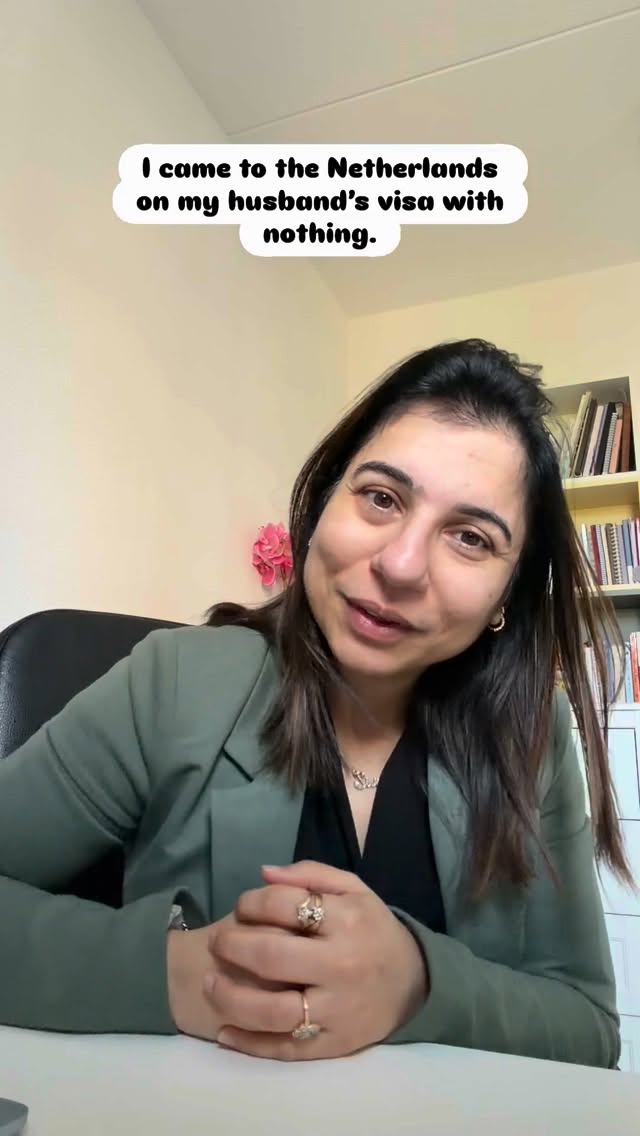
Watch the Reel
Nobody tells you how hard the first year abroad is
My first year in the Netherlands, in under a minute.
Why the first job is the hardest
Here’s what I didn’t understand at first. To an employer here, I was a risk. No Dutch work experience, no Dutch language, no local references, and a CV that looked very different from the ones they usually see.
Once you have one Dutch job on your CV, everything gets easier. Recruiters find you, people can vouch for you, and you understand how things work here. So the first job is not about finding the perfect job. It’s about getting in.
What finally worked for me
Applying online alone wasn’t working. What changed things was talking to people. I started messaging people on LinkedIn who worked in the field I wanted, asking for advice and a little of their time. Not everyone replied, but some did, and those conversations turned into introductions. That’s how I got my first job in the Netherlands, about four to five months after I arrived: a digital marketing role at a startup.
It wasn’t my dream job. But it was in English, it was local experience, and it was a start. Everything after that, including my move into tech, was built on that first step. I wrote down the full story in how I found my first job in the Netherlands on LinkedIn.
What I’d tell you if you’re on a partner visa right now
1. Treat the job search like a project, not a mood
Some days you’ll feel motivated, some days you won’t. That’s normal. A small daily routine helps a lot: a few applications, a few messages, a bit of learning. Small steps, every weekday.
2. Make your profile easy for Dutch recruiters
Recruiters here are busy and get many applications. Make it easy for them: a clear LinkedIn headline, your location set to the Netherlands, and that one line about your right to work. Write your CV in English unless the job ad is in Dutch.
3. Don’t wait until your Dutch is perfect
Many international companies, startups and tech teams work in English. Learn Dutch alongside your search, because it helps a lot in daily life and opens more doors, but don’t put your career on hold for it.
4. Get local experience in any honest way
A short contract, a role a bit below your level, freelance work or volunteering. Anything that gives you a Dutch reference and a local line on your CV. My first role here wasn’t my dream job, but it opened every door after it.
5. Talk to people every week
Events, meetups, LinkedIn messages, other expats. Most of my opportunities came through people, not job portals. It feels uncomfortable at first. It gets easier.
6. Look after yourself, not just your CV
Moving for your partner can make you feel invisible, especially if you were working before. Get out of the house, join something, learn something, dance, walk, call home. Your confidence is part of your job search too.
Looking for your next job, at home or abroad?
I put everything I used into one Job Search Kit: a CV and LinkedIn check, outreach messages, interview answers and a salary script.
Frequently asked questions
Can I work in the Netherlands on a dependent or partner visa?
Often, yes. If your partner is a highly skilled migrant, your residence card usually allows you to work freely without a separate work permit. For other permit types the rules can differ, so check your card and the IND website for your situation.
What does “arbeid vrij toegestaan, TWV niet vereist” mean?
It means you are free to work and an employer does not need to apply for a separate work permit (TWV) for you.
How long does it take to find a job in the Netherlands as a partner?
It really depends on your field, your experience and the job market. For me it took about four to five months, and the first job was the hardest. Talking to people instead of only applying online made the biggest difference.
Do I need to speak Dutch to get a job?
Not always. Many international companies and tech roles work in English. Dutch helps a lot, so it’s worth learning alongside your search.
Are you on a partner visa right now? What’s the hardest part for you? Tell me in the comments 👇
Leave a Reply